

Ordering the correct amount of concrete helps you avoid delays, unnecessary costs and material waste. Before you place an order, you need to measure the area carefully and calculate the volume of concrete required.
Concrete suppliers usually measure and sell concrete in cubic metres (m³). To calculate the volume, you multiply the length, width and depth of the area.
For example:
Length × Width × Depth = Concrete Volume
You must convert all measurements into metres before completing the calculation.
How Is Concrete Measured?
Concrete is usually measured by volume rather than by weight. In the UK, concrete suppliers commonly use cubic metres to calculate the quantity required for a project.
One cubic metre of concrete fills a space that measures:
- One metre long.
- One metre wide.
- One metre deep.
However, most foundations, slabs and driveways have a much smaller depth. You should convert the depth from millimetres into metres before calculating the concrete volume.
For example:
- A depth of 100 mm equals 0.1 metres.
- A depth of 150 mm equals 0.15 metres.
- A depth of 200 mm equals 0.2 metres.
- A depth of 250 mm equals 0.25 metres.
How Do You Calculate the Amount of Concrete You Need?
You can calculate the concrete volume by using this formula:
Length × Width × Depth = Cubic Metres of Concrete
Measure the length, width and depth of the area in metres. Multiply the three measurements to calculate the required volume.
Example: Calculating Concrete for a Slab
Suppose you plan to pour a concrete slab that measures:
- The slab is 5 metres long.
- The slab is 4 metres wide.
- The slab is 150 mm deep.
First, convert the depth:
150 mm ÷ 1,000 = 0.15 metres
Next, calculate the volume:
5 × 4 × 0.15 = 3 cubic metres
The project requires approximately 3 m³ of concrete.
How Do You Measure Concrete for a Driveway?
Measure the driveway’s length and width in metres. Then measure the planned concrete depth and convert it to metres.
Use this formula:
Length × Width × Depth = Concrete Volume
For example:
- The driveway measures 8 metres long.
- The driveway measures 4 metres wide.
- The concrete depth measures 150 mm, which equals 0.15 metres.
The calculation is:
8 × 4 × 0.15 = 4.8 m³
The driveway requires approximately 4.8 cubic metres of concrete.
You should also consider the sub-base, reinforcement and drainage requirements before arranging the concrete delivery.
How Do You Measure Concrete for Foundations?
Foundation trenches may have different lengths, widths and depths. Measure each section separately when the foundation does not have a simple rectangular shape.
Use this formula:
Length × Width × Depth = Concrete Volume
For example:
- The trench measures 20 metres long.
- The trench measures 0.6 metres wide.
- The trench measures 0.5 metres deep.
The calculation is:
20 × 0.6 × 0.5 = 6 m³
The trench requires approximately 6 cubic metres of concrete.
If the project includes several trenches, calculate each section and add the results together.
How Do You Measure Concrete for a Circular Area?
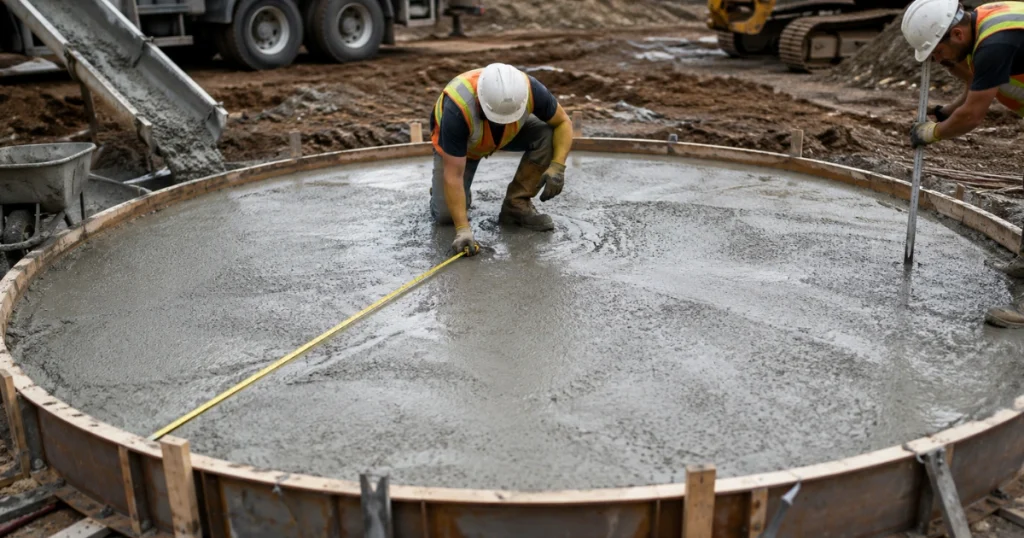
Circular concrete areas require a different calculation.
Use this formula:
π × Radius² × Depth = Concrete Volume
The radius equals half of the circle’s diameter.
For example:
- The circular area has a diameter of 4 metres.
- The radius is 2 metres.
- The concrete depth is 100 mm, which equals 0.1 metres.
The calculation is:
3.14 × 2 × 2 × 0.1 = 1.256 m³
The area requires approximately 1.26 cubic metres of concrete.
Should You Add Extra Concrete to Your Order?
You may need to allow a small amount for uneven ground, minor measurement differences and material loss during the pour.
However, you should not add a large amount without discussing the project with the supplier. Ordering too much concrete can increase your costs and leave unused material.
A concrete supplier can review your measurements and help you estimate the required quantity.
You should check the following before adding extra concrete:
- You should confirm that your length and width measurements are accurate.
- You should measure the concrete depth at several points when the ground is uneven.
- You should calculate separate sections when the area has an irregular shape.
- You should discuss the final quantity with the concrete supplier before placing the order.
What Information Do You Need Before Ordering Concrete?
The supplier needs accurate project details to provide the correct concrete mix and delivery service.
You should provide:
- You should explain whether the concrete is for foundations, a slab, a driveway or another project.
- You should provide the length, width and depth of the area.
- You should provide the estimated concrete volume in cubic metres.
- You should confirm the required concrete strength or mix specification.
- You should provide the full delivery address.
- You should explain the available access for the concrete truck.
- You should confirm the preferred delivery date and time.
- You should explain whether the project requires a line pump.
- You should tell the supplier if the project has restricted access or difficult ground conditions.
How Do You Choose the Right Concrete Mix?

Different projects require different concrete mixes. The required mix depends on the project’s structural requirements, expected load and site conditions.
For example:
- Foundation work may require a concrete mix that meets the project’s structural requirements.
- Driveways may require concrete that can support regular vehicle traffic.
- Concrete slabs may require a mix that suits the intended use of the floor or base.
- Structural work may require a specific concrete strength set by an engineer or building specification.
You should check the project drawings or speak with a qualified professional when the work requires a specific concrete grade.
How Is Concrete Ordered?
After you calculate the required quantity, contact a concrete supplier and provide the project details.
The ordering process usually includes the following steps:
- You measure the area and calculate the estimated concrete volume.
- You confirm the required concrete mix or strength.
- You contact the concrete supplier and explain the project requirements.
- You provide the delivery address and site access information.
- You discuss whether you need a concrete line pump.
- You agree on the delivery date and expected time.
- You confirm the quantity and any delivery charges before placing the order.
What Should You Check Before Concrete Delivery?
You should prepare the site before the concrete truck arrives. Good preparation helps the concrete pour run smoothly and reduces delays.
You should check the following:
- You should make sure that the concrete truck has safe access to the site.
- You should remove obstacles from the delivery route.
- You should complete the excavation, formwork and ground preparation.
- You should install reinforcement before the concrete delivery when the project requires it.
- You should make sure that workers and tools are ready before the concrete arrives.
- You should arrange a line pump when the truck cannot reach the pouring area.
- You should confirm the delivery time with the concrete supplier.
Do You Need a Concrete Line Pump?
A concrete line pump can move concrete through pipes from the delivery point to the required area.
You may need a line pump when:
- The concrete truck cannot reach the pouring area.
- The project is located behind a property.
- The site has limited access.
- The concrete needs to travel across a long distance.
- The project requires concrete placement in a difficult location.
A line pump can help the project place concrete more quickly and reduce the amount of manual handling.
Can You Order Small Amounts of Concrete?
Yes. Many concrete suppliers provide concrete for small domestic and commercial projects.
Small concrete orders may suit:
- A garden shed base.
- A small patio.
- A short pathway.
- A small driveway repair.
- A local foundation project.
Mix-on-site concrete can help with smaller projects because the supplier can produce the quantity required at the site.
What Happens If You Order Too Much Concrete?
Ordering too much concrete may increase the project cost and create unused material.
The project team may need to arrange a suitable place for the remaining concrete. You should not assume that the supplier can remove or dispose of unused concrete without prior agreement.
Accurate measurements and a discussion with the supplier can reduce the risk of over-ordering.
What Happens If You Order Too Little Concrete?
Ordering too little concrete can interrupt the pour and delay the project.
The project may need an additional delivery, which can increase the cost and affect the work schedule.
You should calculate the quantity carefully and confirm the estimate before placing the order.
Frequently Asked Questions
Is Concrete Measured in Cubic Metres?
Yes. Concrete suppliers commonly measure and supply concrete in cubic metres.
How Do I Convert Millimetres into Metres?
Divide the measurement in millimetres by 1,000.
For example:
150 mm ÷ 1,000 = 0.15 metres
How Much Concrete Does One Cubic Metre Cover?
The coverage depends on the concrete depth.
For example:
- One cubic metre can cover approximately 10 square metres at a depth of 100 mm.
- One cubic metre can cover approximately 6.67 square metres at a depth of 150 mm.
- One cubic metre can cover approximately 5 square metres at a depth of 200 mm.
Can a Concrete Supplier Help Me Calculate the Quantity?
Yes. You can provide the project measurements to the supplier, who can help you estimate the required concrete volume.
Do I Need to Know the Concrete Mix Before Ordering?
You should know the required mix or explain the project type to the supplier. The supplier can help you identify the appropriate concrete specification, but you should follow any requirements provided by an engineer, architect or building specification.
Can I Change the Quantity on Delivery?
The available options depend on the concrete supply method. Mix-on-site concrete may provide more flexibility because the supplier produces the concrete at the construction site.
Final Words
Concrete suppliers usually measure concrete in cubic metres. You can calculate the required quantity by multiplying the length, width and depth of the area.
Measure every part of the project carefully, convert all measurements into metres and calculate separate sections when the shape is irregular.
Before placing an order, confirm the concrete quantity, required mix, site access, delivery date and pumping requirements. Accurate planning can help you reduce waste, avoid delays and keep the concrete pour organised.